Showing posts with label Monuments. Show all posts

Thursday, September 29, 2011

Inside the Jefferson Memorial

I had a few difficulties logging in today. Please accept this cell phone snap shot of Jefferson as my humble apology for the late post.

Thursday, September 1, 2011

Far from Picturesque

I mentioned the Reflecting Pool in yesterday's post. This is what it looks like right now. Forest would have had a harder time running through that.

Wednesday, August 31, 2011

The Stone of Hope


This is the new Dr. Martin Luther King Jr. monument, which was dedicated on the National Mall this weekend to mark the anniversary of the "I Have a Dream" speech given on August 28th, 1963.

The inscription on one side reads "Out of the mountain of despair, a stone of hope." Fittingly, the figure of King is, to put it in appropriate Biblical terms, "hewn out of the mountain." The visitor approaches the memorial from behind, passing figuratively through the mountain with him, before rounding the monument to view it from the front.

There has been a lot of controversy surrounding the monument--whether the image of King was exaggeratingly racialized, the enormous licensing fees paid to the King family for use of King's image and quotations, the later egregious misquoting of speeches used in the memorial, choosing a Chinese sculptor whose other famous works include a monument to Moa Zedong, and the list really goes on, all the way down to whether the design itself was an appropriate representation for the tribute. But, really, there will always be controversy. If the Washington Monument or the Lincoln Memorial were being built today, there would be an outcry. No doubt in time, the Dr. Martin Luther King Jr. Memorial will become as much a part of the recognizable landscape of the National Mall as the Reflecting Pool, where the crowds gathered that day to hear that immortal speech.

One of my favorite tributes to Dr. King is Patty Griffin's song "Up to the Mountain," which was inspired by the last speech Dr. King gave. It's full of emotion and soulful gospel lyricism that is reminiscent of Dr. King's speeches.

Monday, August 29, 2011

District Daily Natural Disaster

So it was a pretty busy week in DC. You might have seen something about that on the news. As Irene began rolling towards the city, workers scrambled to patch cracks left in the Washington Monument by Tuesday's earthquake. One of these cracks was four feet long and over four inches wide, making the sky above visible from inside the monument. They managed to temporarily patch the cracks, but many of them are still visible. If you click to view the larger version of this photo, you can see cracks shooting off from the corners of the observation window on the right. A larger crack, where the stones are visibly misaligned, can be seen in the center stone, three stones up from the circular lights. The monument is closed indefinitely. The hurricane, luckily, caused minimal damage to the city--much less than expected. But, as you can see, the rain finally cleared away.

Wednesday, July 13, 2011

Navy Memorial

The sailor stands on the edge of the Navy Memorial, looking towards the open plaza, which is paved to represent the globe. The Navy Memorial is a popular meeting place in DC, and on Tuesday nights, the Memorial hosts free concerts.

Thursday, June 23, 2011

Daguerre at the Office

This monument to Louise Daguerre stands outside of the Smithsonian Museum of American Art and American Portraiture, which I may have mentioned a few times...as where I often spend my days. For some reason, I had never noticed this monument to Daguerre until a few days ago, which is pretty odd considering that a good portion of my time at the museum is spent researching photography.

As his name suggests, Louis Daguerre was the inventor of the daguerreotype, one of the earliest methods of photography. Daguerre worked on his method throughout the 1830s and finally presented it to France's Académie des science in 1839. The daguerreotype was heralded as a wonder of modern science, but it was also looked at with skepticism and explicit paranoia. What if someone takes a daguerreotype of you--Does that image belong to you or the daguerreotypist? This was at a time when privacy was closely associated with social status. Well-bred people didn't expose themselves to public scrutiny. What if your image was used in something really vulgar like a placard for soap or some medicinal tonic. There would be a scandal!

But not nearly as notorious as the scandal that was reported only a few months after the daguerreotype process was revealed, in which a French gentleman claimed to have made a daguerreotype of his young wife with her lover. Incroyable! Photography could be used as evidence in cases of infidelity. Comment dit-on en francais "Gumshoe?" One of the most remarkable things about this case is that the daguerreotype was accepted as evidence, apparently, without even being seen. What no one stopped to consider is that the exposure time for a daguerreotype meant that the subject, if human, had to remain very, very, very still. If the Frenchman had managed to capture the tryst, the image would be blurry at best.

The process of producing a daguerreotype was extremely complicated and required constant exposure to any number of lethal chemicals. It consisted basically of a glass plate covered in silver alloy, which was treated with chemicals that made the alloy photosensitive. The result was a strikingly detailed image. The closer the plate was to the aperture in the daguerreotype camera box, the smaller the surface of the plate would be exposed to light, and the less defused the light would be; that is, the smaller the image, the more detailed. There is one story of a photographic plate that looked as though it had a speck of dust or a small scratch, but when examined with a microscope, it was a perfect portraiture. The implications were immediate. Spies could transport glass plates with microscopic reproductions of documents or maps, all in the guise of a photographer. If questioned, they would be found only with seemingly unexposed plates. Or, perhaps less intriguing, Britain's entire public archive could be stored on a few glass plates. The possibilities were endless.

When Fox Talbot, an English inventor, heard of of the daguerreotype, he announced his own simultaneous invention, which he had been keeping private. Talbot perfected his process for many years, introducing the first photographic negatives. Daguerreotypes were metal plates; they couldn't be reproduced. Talbot's negatives (The term was coined much later.) could be used to reproduce multiple prints on paper. The daguerreotype enjoyed some popularity in the United States, but within the UK, its success was short lived, and the daguerreotype soon disappeared, along with its characteristic fine details, which were lost until well into the 20th century.

See, I told you, super nerdy.

Monday, February 28, 2011

Not Technically the District Daily Photo

This is the George Washington Masonic National Memorial. Thanks to Dan Brown, et al., pretty much everyone knows that George Washington was a Mason, and Washington, DC is full of Masonic temples, symbols, and conspiracies. I moved to DC not long before The Lost Symbol came out, and I can tell you that Washington wasn't very excited about Dan-Brownian tourists' assumptions and misinformation. It was like living near Paris when The Da Vinci Code came out; everyone hated Dan Brown. And I just now realized that he always releases a book about a place not long after I move there. Coincidence? hmm... Anyway, the Masonic Lodge in Alexandria was named for George Washington because he was a member there. And while it's not technically in the District, it is in the Washington Metro area, or as locals call it, the DMV--DC, Maryland, Virginia.

Wednesday, February 23, 2011

Happy Birthday, Other Big Guy.


Lincoln may be bigger, but George is a better dresser. Every year for George Washington's birthday, the DC university named in his honor has a party; so of course George gets dressed up for the special occasion. There's a bonfire, s'mores, cupcakes, and sometimes even a fife and drum corps. This statue, which stands in University Yard, has an identical twin that stands outside of the National Gallery in London. When that statue was sent to London, it was shipped along with a crate of dirt so that Washington would always be standing on Virginia soil. To my knowledge, it did not arrive with a feather boa.

See more here.

Wednesday, February 16, 2011

Mercury Rising


It's finally getting warmer in the District! As winters go, this one actually hasn't been so bad for DC. The blizzards that hit us over and over last year headed to New York City instead, I guess. When it's cold outside, though, it's a great time to head indoors to the museums. There aren't as many tourists in the winter, and you have the place pretty much to yourself. The photo above is of Mercury, rising, no less, atop of Wind's breath. This fountain is in the rotunda (to continue with yesterday's theme) of the West Building of the National Gallery of Art.

Click here for a few more shots from the NGA.

Tuesday, February 15, 2011

On the Inside


I love taking pictures of the US Capitol Building. It's so intricately detailed that it's gorgeous in any lighting. It was a marvel of modern architecture and, of course, still is an icon in international politics. It also helps that it's conveniently located.

The inside of the massive dome is just as stunning. In the center of the great rotunda is "The Apotheosis of Washington," which is literally about the deification of George Washington, the first President of the United States. I think the fresco epitomizes the intersection between Enlightenment ideals and the government, a tradition that is often overlooked by those that argue for Christianity as the basis of government. Right there, in the very core of our democracy, is a symbolic image of pagan idolatry.

Sunday, February 13, 2011

Happy Birthday, Big Guy.


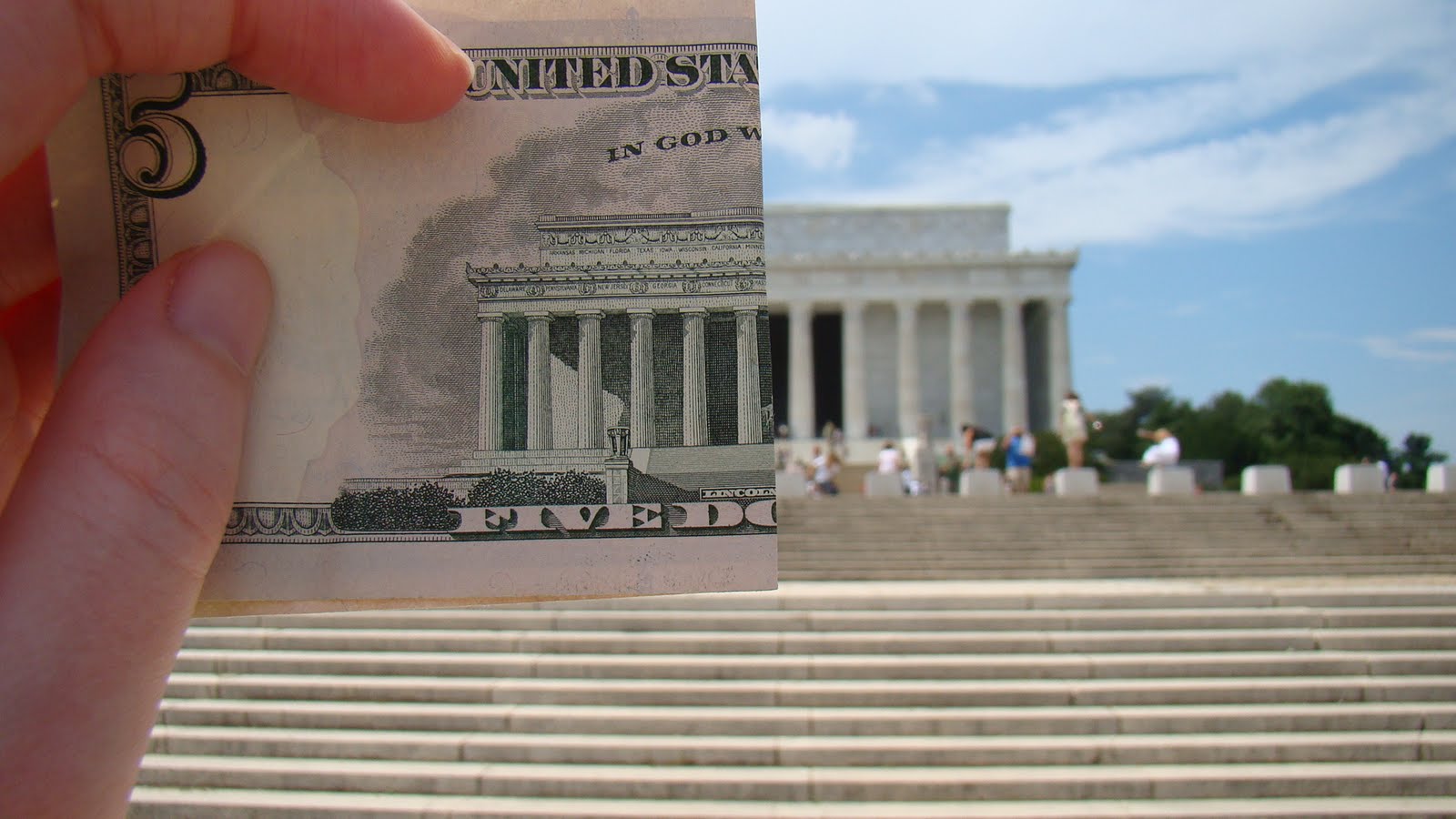
In honor of Abraham Lincoln's birthday, here's a total touristy shot. Lincoln's birthday was actually yesterday, but Saturday's post was preempted by Egypt. It seems kind of appropriate; after all, Lincoln has already had 202 birthdays, and since he did dedicate his life to ending oppression, I'm sure he doesn't mind belated wishes

Friday, February 11, 2011

American Red Cross Headquarters


This monument "To Those We Serve" is outside the International Headquarters of the American Red Cross, on the corner of E and 20th NW. For more images of the monument, you can visit my personal blog.